Birthmarks can correspond to previous-life wounds
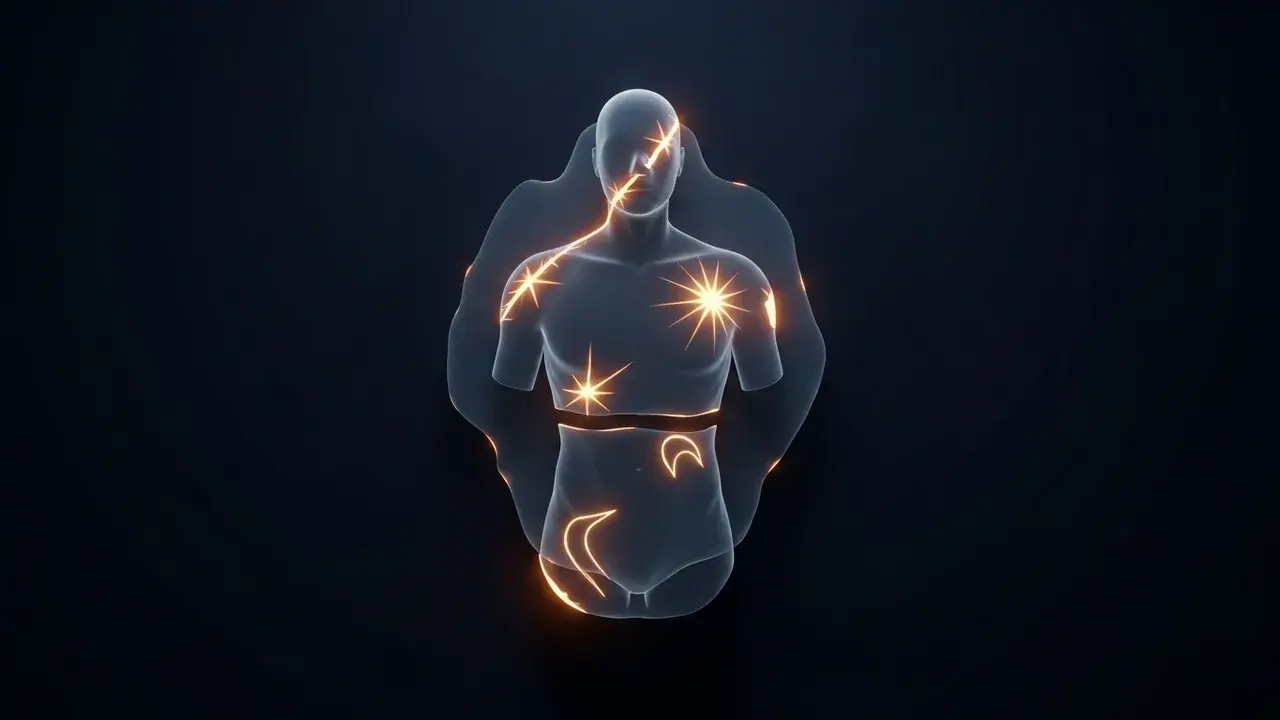
Can a birthmark match a wound from the life a child remembers?
A subset of past-life cases include birthmarks or birth defects whose location matches reported wounds — sometimes with autopsy verification.
The white-paper layer for this claim
This page is backed by 6 linked sources: 6 verified, 5 primary, 0 direct objections, and 0 methodology anchors. The full source list stays at the bottom so the claim, objections, and citations can be checked together.
The institutional home for serious empirical work on past-life memories and survival-related anomalies.
The most detailed primary case-archive specifically targeting the birthmark/wound correspondence claim.
A shorter primary paper that makes the birthmark/wound claim directly, useful beside the much larger 1997 monograph.
What people actually report
The reports exist and deserve examination. The question is how much weight to give them.
In a subset of past-life cases studied by Ian Stevenson, the child has birthmarks or birth defects that, according to investigators, correspond in location and shape to fatal wounds on the deceased person they claim to remember being — for example, two marks lining up with bullet entry and exit points. Stevenson published medical photographs and autopsy correspondences in a two-volume work; how reliable those correspondences are is contested.
The strongest arguments in favour
Before examining the objections — here are the reasons thoughtful people take this seriously, regardless of where it ultimately lands.
- 01Stevenson's 'Reincarnation and Biology' (1997) catalogued more than 200 cases.
- 02Some cases include autopsy or medical records corroborating wound location.
- 03The pattern occurs across cultures and is not limited to suggestion-prone families.
The strongest objections
Now the other side. These are the most compelling reasons to remain skeptical.
- 01Sample of well-documented cases remains small.
- 02Birthmarks are common; chance correspondence is non-trivial in retrospective matching.
- 03Limited independent replication.
Where this stands
Having seen the best case on both sides, here is our overall read.
Stevenson's later work on birthmarks and birth defects (Reincarnation and Biology, 1997) documents striking case-by-case correspondence. The sample is small, the methodology has been scrutinized, and the findings have not been independently replicated at scale.
That at least some birthmark cases involve correspondences hard to explain by ordinary chance.
That trauma is biologically transmitted between lives, or that reincarnation as commonly understood is occurring.
Phenomenon vs interpretation
The signature distinction. We score the underlying observation separately from the metaphysical framework usually attached to it.
Evidence the reported observation is real.
Evidence the bigger explanation is correct.
Headline score (defaults to phenomenon score for phenomena).
Distance between data and conclusion.
What a thoughtful person might do with this
Note unusual birthmarks alongside spontaneous statements; do not draw conclusions from a single case.
How belief in this can go wrong
Easily used to overinterpret coincidence; risks mythologizing children's bodies.
Audit trail
The 11 internal criteria informing the headline scores. They're not arithmetically averaged — they're the audit trail.
Related research reports
Longer synthesis pages that place this claim inside a wider evidence cluster.
Related claims
Sources & Further Reading
Our goal is to link to original studies, academic sources, and serious critiques wherever possible. Scores are provisional until sources are verified.
Primary sources
Division of Perceptual Studies — Publications
The institutional home for serious empirical work on past-life memories and survival-related anomalies.
Reincarnation and Biology: A Contribution to the Etiology of Birthmarks and Birth Defects
The most detailed primary case-archive specifically targeting the birthmark/wound correspondence claim.
Birthmarks and birth defects corresponding to wounds on deceased persons
A shorter primary paper that makes the birthmark/wound claim directly, useful beside the much larger 1997 monograph.
Children's reports of past-life memories: A review
Exactly the sort of review the user-facing example refers to — written by the principal investigator at DOPS.
Further reading
Division of Perceptual Studies
The leading academic group publishing on cases of children claiming past-life memories and on Greyson's NDE work.
Reincarnation research
Companion to the UVa DOPS institutional page; covers the case-study methodology and the major sceptical objections.
Research and sources for this claim
A source-linked synthesis of past-life memory cases, birthmark claims, reincarnation interpretations, and skeptical alternatives.
Modern review anchor for children's past-life memory reports and interpretation limits.
Major case-collection source for birthmark and birth-defect claims.
Focused wound-correspondence source where documentation standards matter most.