DMT entities are real beings
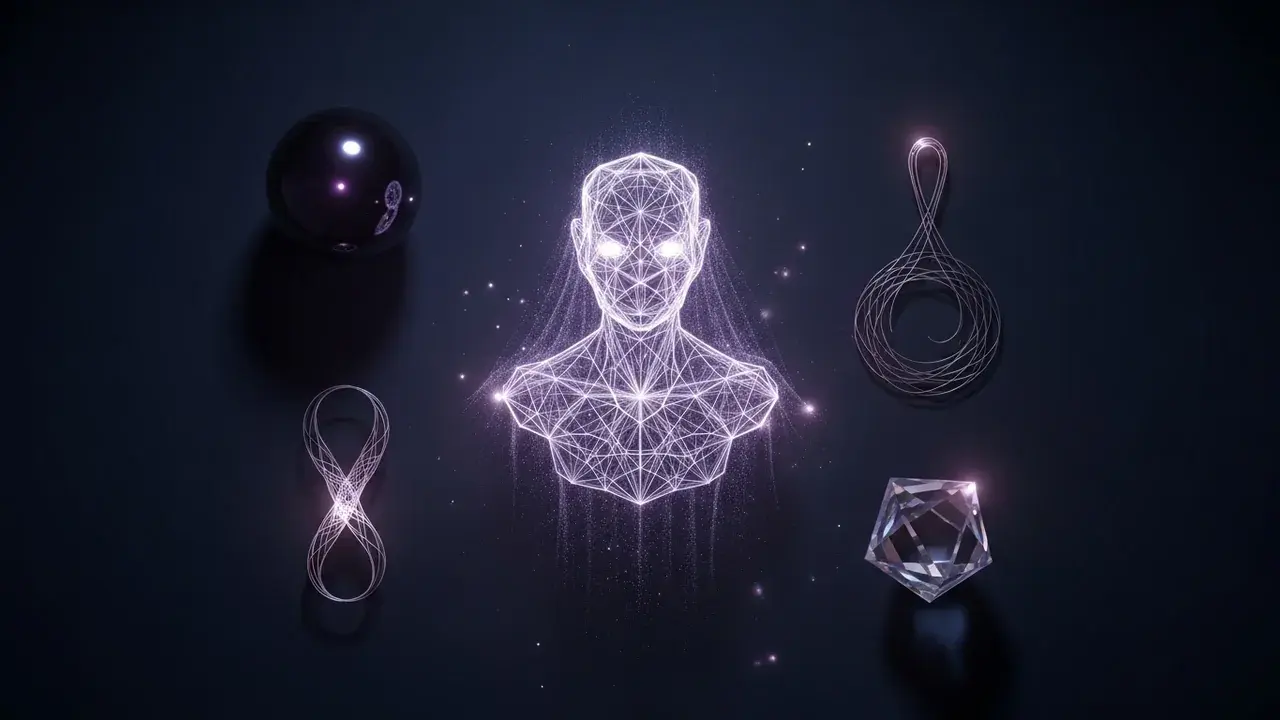
Are the entities people meet on DMT actually independently existing beings?
The encounters are reliably induced and structurally consistent. Whether the 'machine elves' exist independently is a separate enormous claim.
Something — or someone — seems to be in there
The starting point isn't a theory. It's a category of experience that, on a high enough dose of DMT, almost everyone reports.
During high-dose DMT (and especially ayahuasca) experiences, many users describe encountering apparently autonomous beings — sometimes called 'machine elves,' sometimes humanoid figures, sometimes 'guides' — who feel like external intelligences rather than products of the user's own mind. Rick Strassman's *DMT: The Spirit Molecule* drew attention to the consistency of these reports across users. The claim is that these entities exist independently of the experiencer in some meaningful sense.
The question we're working on isn't whether the encounters happen — they reliably do. It's what the encounters are: a vivid feature of brain pharmacology, or contact with something the brain is more like a receiver for.
Why people take this seriously in the first place
Before judging the claim, it helps to understand why it's not in the same category as ordinary hallucination reports.
- The encounters are reproducible
On a sufficient dose of DMT, the entity-encounter experience isn't rare or marginal — it's the central feature of the experience for most users. That alone separates it from idiosyncratic hallucination reports.
- The descriptions converge
Independent reports keep landing on a small set of recurring features: machine-elf-like or insectoid beings, geometric and architectural spaces, beings that seem to expect the visitor and want to communicate.
- The entities feel autonomous
Users routinely describe the beings as having their own intentions, humour, and agendas — not as projections of the experiencer's thoughts. The Johns Hopkins entity-encounter survey (Davis et al., 2020) found a striking majority rated the entities as conscious, intelligent, and aware of them.
- The experience is reported as more real than reality
Possibly the strangest signature feature: many users describe the encounter as more real, more vivid, and more meaningful than ordinary waking life — and continue to describe it that way years later, even when they no longer believe the entities were literal.
- Strassman put it on the clinical record
Rick Strassman's DEA-sanctioned DMT studies at the University of New Mexico (later written up in DMT: The Spirit Molecule, 2001) catalogued the consistency of the entity reports under controlled clinical conditions — not just in the psychedelic underground.
- There's a long indigenous parallel
Amazonian ayahuasca traditions (which deliver oral DMT in combination with an MAOI) describe encounters with similar classes of beings — plant teachers, guides, mother spirits — embedded in a cosmology that long predates the Western DMT literature.
The kinds of reports people describe
Below are commonly reported patterns from the DMT and ayahuasca literature — not personal testimonials, and not verified facts. They're a composite of features that recur across thousands of trip reports, Strassman's clinical interviews, and the Johns Hopkins entity-encounter survey.
- 01The 'breakthrough' into a hyper-real space
After a few seconds of geometric overload, many users describe the visual field opening up into what feels like a fully formed environment — often described as a chamber, a domed room, a 'jewelled' or fractal architecture. The space feels stable, coherent, and inhabited.
- 02Beings that seem to be waiting for you
A repeated motif: the moment the user 'arrives,' beings turn toward them as if they were expected. People often describe a sense of recognition or welcome — sometimes affectionate, sometimes amused, sometimes urgent.
- 03Insectoid, mantis-like, or 'machine elf' figures
Specific entity types recur with surprising frequency in independent reports: praying-mantis-like figures conducting examinations, jewelled or mechanical 'elves' performing intricate operations, geometric beings made of language. Terence McKenna popularised the term 'self-transforming machine elves' for one of these classes.
- 04Information transfer that feels too dense to be self-generated
Users frequently report being shown things — symbols, geometries, ideas — at a rate they describe as impossibly fast and structured. Whether this is genuine information or pattern-recognition under exotic neurochemistry is exactly the contested question.
- 05A felt instruction not to forget
Many trip reports describe the entities urging the user to remember, pay attention, or carry something back. The 'message' often resists translation back into words once the experience ends — which the experiencer treats either as evidence of depth, or as a clue about the limits of the brain on DMT.
- 06More real than real
When people are asked, days or years later, whether the experience felt like a dream or a hallucination, the modal answer is some version of: no, it felt more real than ordinary life. This 'noetic' weight is one of the things hardest to explain on a purely dismissive reading.
- Strassman, R. (2001). DMT: The Spirit Molecule. Park Street Press. Clinical interviews with volunteers in the University of New Mexico DMT studies.
- Davis, A. K., Clifton, J. M., Weaver, E. G., Hurwitz, E. S., Johnson, M. W., & Griffiths, R. R. (2020). Survey of entity encounter experiences occasioned by inhaled N,N-dimethyltryptamine: Phenomenology, interpretation, and enduring effects. Journal of Psychopharmacology, 34(9), 1008–1020.
- McKenna, T. — talks and writings popularising the “self- transforming machine elves” framing of high-dose DMT encounters.
The strongest case that something more is going on
If you take the encounters at face value, these are the threads that make people wonder whether the entities are more than hallucinations.
- 01The encounters are reliably and reproducibly induced under clinical conditions, not just in unstructured recreational settings (Strassman, 1990s clinical studies; later Hopkins survey work).
- 02Independent users with no shared cultural frame keep describing structurally similar beings, environments, and interaction patterns — convergence that is harder to attribute purely to expectation.
- 03Survey work (e.g. Davis et al., 2020, Johns Hopkins) finds that a majority of respondents rate the entities as conscious, intelligent, benevolent, and aware of them — and that many report lasting positive shifts in worldview, anxiety, and meaning afterwards.
- 04The experience is reported as 'more real than real' even years later, by people who have moved on from any literal interpretation. That noetic quality is unusual for a hallucination.
- 05Cross-cultural overlap with traditional Amazonian ayahuasca cosmologies, which were describing 'plant teachers' and entity encounters long before Western pharmacology had a chemical name for what was happening.
- 06If consciousness turns out not to be exclusively brain-generated — which is itself an open research question — then 'something is genuinely being contacted' becomes at least a coherent possibility rather than a category error.
The strongest skeptical case against it
A vivid experience is not the same as an external one. Here's what the skeptical reading looks like once you take the experience as seriously as it deserves.
- 01DMT massively alters perception, agency-detection, and the sense of self. Brains under exotic neurochemistry are very capable of producing convincing autonomous-seeming agents — see also dreams, sleep paralysis, hypnagogia, and acute psychosis.
- 02The entities behave roughly the way you'd expect brain-generated agents to behave: they reflect the user's emotional state, draw on their cultural priming, and rarely deliver verifiable, novel information that the user couldn't have produced themselves.
- 03Cultural priming is doing visible work: people steeped in McKenna's writing tend to meet machine elves; people in an ayahuasca lineage tend to meet plant spirits; people from religious backgrounds tend to meet beings in those forms.
- 04Vividness and the 'more real than real' quality are themselves features the brain can produce — temporal-lobe phenomena, lucid dreams, and certain meditative states all generate similar noetic reports without anyone arguing they prove external contact.
- 05There is, so far, no reliable independent evidence that any DMT entity exists outside the experiencer's mind. No verified veridical perception, no consistent cross-trip information, no test that any entity has been able to pass.
- 06Pharmacology offers a clean, parsimonious explanation: 5-HT2A activation, disrupted predictive processing, and altered self-modelling reliably produce vivid agentic experiences. We do not need an additional metaphysical layer for the phenomenon.
Where this stands, after seeing both sides
Now that the most compelling material is on the table, here's our overall read.
The DMT entity-encounter phenomenon is robust and surveyable. The interpretation that these entities are independently existing beings rather than constructions of the brain is among the largest interpretive leaps in this entire dataset.
That entity-encounter experience is a reliable, structured feature of DMT/ayahuasca pharmacology.
That the entities exist outside the experiencer.
Phenomenon vs interpretation
The signature distinction. We score the underlying observation separately from the metaphysical framework usually attached to it.
Evidence the reported observation is real.
Evidence the bigger explanation is correct.
Headline score (defaults to phenomenon score for phenomena).
Distance between data and conclusion.
What a thoughtful person might do with this
Take the experience seriously as data; do not act as if the entities are real interlocutors.
How belief in this can go wrong
Strong tendency to construct cosmologies around encounters; major mental-health risks for predisposed users.
Audit trail
The 11 internal criteria informing the headline scores. They're not arithmetically averaged — they're the audit trail.
Related claims
Sources & Further Reading
Our goal is to link to original studies, academic sources, and serious critiques wherever possible. Scores are provisional until sources are verified.
Primary sources
Survey of entity encounter experiences occasioned by inhaled N,N-dimethyltryptamine: Phenomenology, interpretation, and enduring effects
The key modern empirical anchor for DMT entity pages: it supports the robustness of entity-encounter reports while not proving external beings.
A thematic and content analysis of DMT experiences from a naturalistic field study
Adds qualitative depth to the DMT entity record without treating subjective encounter structure as evidence that the entities exist independently.
Further reading
Mysticism
Use this as the conceptual anchor for non-dual, unitive, and psychedelic-mystical claims. It supports the seriousness of the experience category without treating the metaphysical interpretation as settled.
N,N-Dimethyltryptamine
Useful background for entity-encounter claims because it anchors the experiences in known pharmacology before evaluating metaphysical interpretations about independent beings or alternate realms.