Play — how different worldviews interpret a situation.
The evidence map answers what is most likely true. Play asks a different question: if you looked at a situation through a particular philosophical, scientific, or spiritual lens, what would it suggest? Lenses are interpretation models, not equal truths — every lens carries an evidence-status label and a risk warning.
What you’re seeing
- 12 playable scenarios with 57 authored lens responses. Click any scenario to play: pick your own answer first, then reveal each lens one at a time.
- 9 seed lenses, each collapsible — click any one to expand its full schema (assumptions, strengths, weaknesses, risk warning, related claims and worldview models).
- Still preview-only — no unlocks, no scoring, no worldview profiles. Those land in V4.
Twelve scenarios, click any one to play.
Each scenario asks for your own call first, then reveals how each lens interprets the case — reasoning, assumptions, what it teaches, and a per-response risk warning.

The Trolley Problem
A runaway trolley is heading down a track toward five workers who cannot escape. You stand beside a lever that would divert the trolley onto a side track, where one worker stands alone. If you pull the lever, the five live and the one dies. If you do nothing, five die and one lives.
Do you pull the lever?
Lying to save someone
Someone you love is hiding from a person who has stated they intend to harm them. The pursuer arrives at your door and asks where your loved one is. A lie would protect them. The truth would put them at serious risk.
Do you lie?

Price gouging during disaster
After a natural disaster, the only generator vendor in the area raises prices five-fold. Some buyers can no longer afford one. Others, who can, get power back faster. The high price also incentivises distant suppliers to bring in more generators sooner.
Is the price increase morally acceptable?
A child remembers a past life
A four-year-old gives spontaneous, specific, verifiable details about the life of a stranger who died years before the child was born — names, places, manner of death — and a careful investigator confirms the match.
What is the most reasonable interpretation?
A near-death experience with a life review
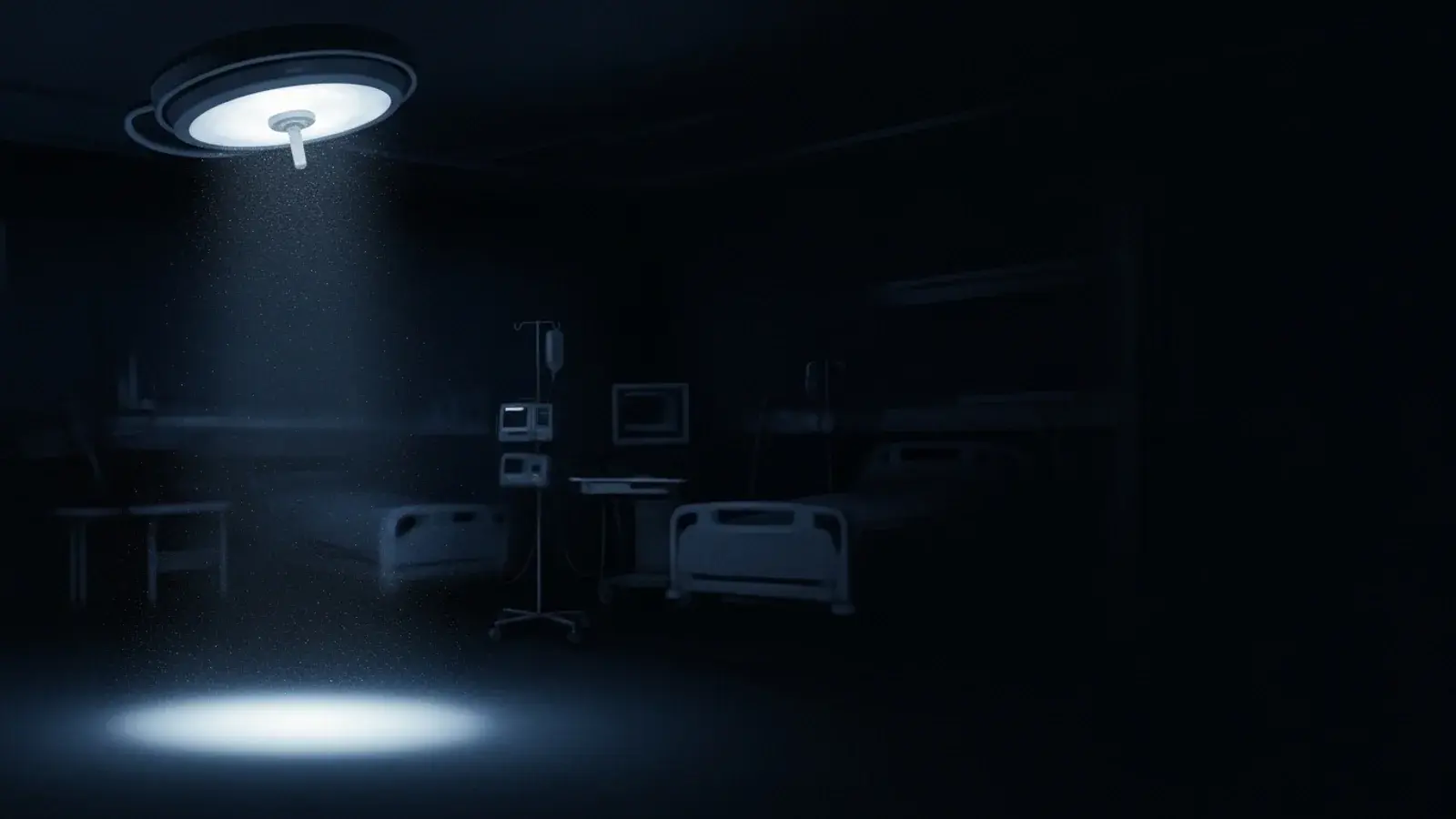
During cardiac arrest, a patient reports a vivid life review: experiencing their own past actions from the perspective of the people they affected, without judgment but with full clarity. They return changed. Hospital staff confirm they had no measurable brain activity for several minutes.
What is the most honest interpretation?

Terminal lucidity before death
An elderly relative with severe long-term dementia, who has not recognised family for years, becomes fully lucid hours before death. They name everyone correctly, recall recent events, say goodbye, and die soon after.
What does this episode actually tell us?

Animal grief and consciousness
A dog whose lifelong companion has died refuses to eat for days, returns repeatedly to the spot where the companion slept, and shows behaviour that in a human we would unhesitatingly call grief.
Is the dog conscious of loss in a morally meaningful way?
Choosing money versus growth
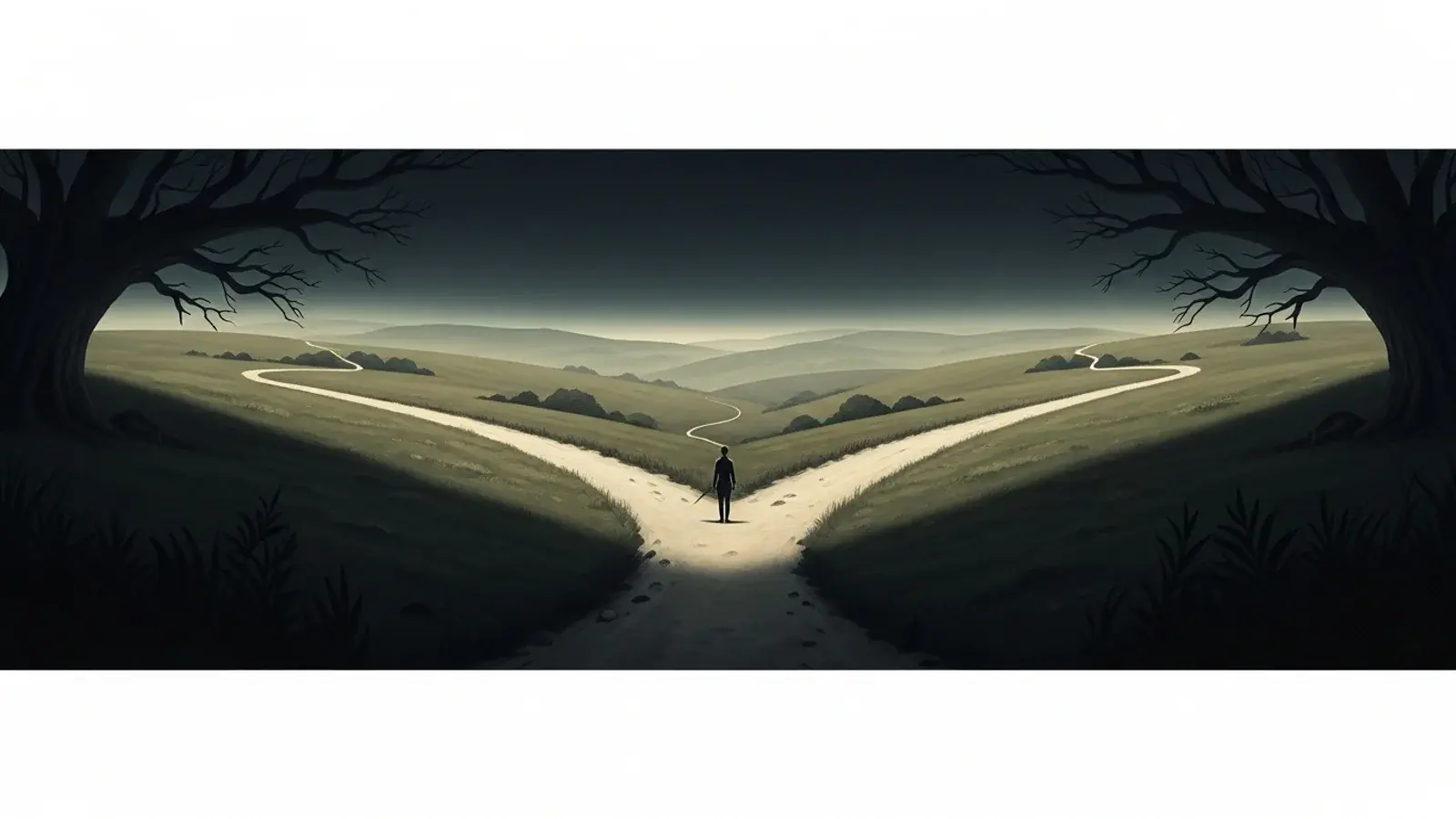
You can take a high-paying job that bores you and constrains your time, or a lower-paying role that stretches you, scares you a little, and aligns with what you care about. Both are stable.
Which do you take, and why?

Staying in a difficult relationship because it teaches you
A long-term relationship is not abusive but is consistently difficult. You believe staying is teaching you patience, honesty, and the limits of your character. Leaving would also be reasonable and safe.
Do you stay because it is teaching you, or do you leave?
If the future already exists, do choices matter?
Suppose the block-universe view is correct: past, present, and future all exist equally, and what you will do tomorrow is already a fact about reality, fixed in the same sense yesterday is fixed.
Do your choices still matter, and in what sense?

If consciousness is brain-produced, what happens at death?
Suppose the strict physicalist view is correct: consciousness is entirely produced by the brain, and when the brain stops, the conscious self ends.
How should you live, knowing that?

If reincarnation is real, what should you optimise your life for?
Suppose reincarnation is real: the same continuous self moves between lives, carrying forward something from each — habits, lessons, perhaps debts.
What should you optimise your current life for?
Nine starter lenses, spanning ethics, science, spirit, and skepticism.
Each lens has an evidence-status label and a risk warning so Play cannot collapse into 'all worldviews are equal'.
 ethical
Utilitarian lens
Philosophically seriousPhilosophically seriousThe right action is whichever produces the greatest overall wellbeing and least suffering.
Utilitarian lens
- Wellbeing and suffering can be meaningfully compared across people.
- Consequences are the primary moral fact.
- Aggregating outcomes is a coherent moral procedure.
- Triage decisions under scarce resources.
- Public-policy trade-offs across large populations.
- Why preventing severe suffering usually outweighs minor inconvenience.
- Why some violations of persons feel wrong even when outcomes are net-positive.
- Rights, dignity, and promises that resist outcome-aggregation.
- Cases where the calculus is impossible to actually run.
Pushed too far, utilitarian reasoning can justify treating individuals as means to a greater good and erodes moral intuitions about rights and dignity.
 ethical
Deontological lens
Philosophically seriousPhilosophically seriousSome actions are right or wrong in themselves, regardless of outcome — duties and rules come first.
Deontological lens
- Persons have intrinsic moral worth that cannot be traded away.
- Some duties (do not lie, do not kill the innocent) hold across cases.
- Moral reasoning is rule-bound, not outcome-driven.
- Why honesty, promise-keeping, and consent matter even when violation would help.
- Resistance to slippery-slope erosion of basic rights.
- Strong intuitions against using a person purely as a tool.
- Tragic dilemmas where every action breaks some duty.
- How to weigh duties against each other when they conflict.
- When rigid rule-following produces clearly worse outcomes.
Pushed too far, deontological reasoning becomes rule-worship and can produce serious harm in the name of obeying a principle.
 ethical
Virtue ethics lens
Philosophically seriousPhilosophically seriousThe right action is whatever a person of good character would do — focus on becoming wise, courageous, just, and temperate.
Virtue ethics lens
- Character traits are real and can be trained over time.
- There are traits broadly recognised across cultures as virtues.
- Practical wisdom — knowing how to act in this case — is teachable.
- Why moral education and habit-formation matter.
- Why good people sometimes do better than rule-followers in unfamiliar cases.
- Why long-term character shapes short-term decisions.
- Disagreement about which traits actually count as virtues.
- How to act when no clear character template exists for a novel case.
- How to evaluate a virtuous-seeming person whose actions cause harm.
Pushed too far, virtue ethics can become self-focused — optimising for being a good person rather than for actually doing good in the world.
 scientific
Physicalist lens
Evidence-backedEvidence-backedEverything that exists is physical or reducible to physical processes — including mind, meaning, and morality.
Physicalist lens
- Physical causation is the only real causation.
- Mental states are ultimately brain states.
- Apparent anomalies have ordinary physical explanations once investigated carefully.
- The reliability of physics, chemistry, and neuroscience.
- Why most paranormal claims fail to replicate under controlled conditions.
- How damage to the brain reliably alters mind.
- The subjective character of conscious experience itself.
- Carefully documented cases where ordinary explanations do not fit cleanly.
- Why physicalism itself is true rather than an arbitrary stipulation.
Pushed too far, physicalism becomes pre-emptive dismissal — explaining away anomalies before they have been investigated, and treating subjective experience as if it does not exist.
 spiritual
Soul-growth lens
Plausible but speculativePlausible but speculativeLife is a curriculum — situations are arranged, partly or wholly, to develop the soul over time.
Soul-growth lens
- There is a continuous self that persists across or beyond a single life.
- Difficulty has formative purpose, not just causal accident.
- Some intelligence — internal, external, or both — orders the curriculum.
- Why people often report meaningful growth from severe difficulty.
- The psychological power of reframing painful events.
- Why life-review experiences feel pedagogical rather than punitive.
- Suffering with no apparent growth (early death, severe brain injury).
- Why the curriculum looks identical to randomness from inside it.
- How to test the model rather than only feel it.
Pushed too far, the soul-growth lens explains away injustice, blames victims for their circumstances, and discourages action against fixable harm.
 spiritual
Karma lens
Weakly supportedWeakly supportedActions carry moral weight that returns to the actor, possibly across lives — a kind of cosmic moral accounting.
Karma lens
- Moral acts have non-physical causal consequences.
- There is a mechanism — divine, structural, or otherwise — that tracks them.
- Consequences can carry across lifetimes.
- Why most moral traditions converge on similar prohibitions.
- The psychological observation that actions shape character which shapes life trajectory.
- Why people seek meaning in apparent moral asymmetries.
- Direct, falsifiable evidence of cross-life moral bookkeeping.
- Visibly unjust outcomes for clearly virtuous people.
- How the mechanism could plausibly operate without an enforcing agent.
Pushed too far, karma becomes victim-blaming — treating poverty, illness, or violence as deserved consequences of unseen past actions.
 metaphysical
Determinist lens
Philosophically seriousPhilosophically seriousEvery event, including human choice, is fixed by the chain of prior causes — there is no genuinely open future.
Determinist lens
- Causal closure of the physical world.
- Apparent choice is the felt experience of an already-determined process.
- The future is fixed in the same sense the past is.
- Why behaviour is highly predictable given enough information about a person's situation.
- Why luck — birthplace, biology, era — explains so much of life outcomes.
- Reduced moral grandstanding when others' behaviour is seen as caused.
- The pervasive subjective sense of deliberation and choice.
- Quantum-level indeterminacy in physics.
- How moral responsibility survives in any meaningful form.
Pushed too far, determinism produces fatalism, erodes felt agency, and is sometimes used to excuse harmful behaviour as 'just what was going to happen'.
 spiritual
Theist lens
Philosophically seriousPhilosophically seriousReality is grounded in a purposive divine intelligence; meaning, value, and moral order originate there.
Theist lens
- A conscious source of reality exists.
- That source has intentions or values that bear on human life.
- Meaning and morality are grounded outside the human mind.
- Why many people across cultures report a sense of being known or held.
- The deep human intuition that goodness is real, not invented.
- Why moral order feels foundational rather than arbitrary.
- The problem of severe, undeserved suffering.
- The diversity and incompatibility of religious revelations.
- Why direct evidence of the divine remains contested.
Pushed too far, theism can authorise certainty about specific revelations, harden into in-group/out-group morality, and discourage honest engagement with contrary evidence.
 skeptical
Nihilist lens
Useful but riskyUseful but riskyThere is no inherent meaning, purpose, or objective moral order — those are projections we add to a neutral universe.
Nihilist lens
- Meaning and value are not features of the universe.
- Apparent moral facts are descriptions of human preferences.
- Cosmic indifference is the default state of reality.
- Why the universe shows no apparent concern for human flourishing.
- The historical and cultural variability of moral systems.
- Why projecting cosmic meaning onto random events misleads us.
- Why some moral intuitions appear stable across radically different cultures.
- Why meaning, when constructed, still feels real and motivates action.
- How to live well long-term under a strict no-meaning frame.
Pushed too far, nihilism corrodes motivation, undercuts shared moral commitments, and is easily co-opted to justify harm under the slogan 'nothing matters'.
Where this lives in the plan
- V1Evidence Map + Best-Fit Worldviewshipped
- V1.5Claim pages get a 'competing explanations' railnext
- V2Worldview Builder — user-tunable weights → personal modelplanned
- V3Play / Thought Experiments (this preview)scaffolded
- V4Users unlock lenses by exploring and build a worldview profileplanned