Boltzmann brains
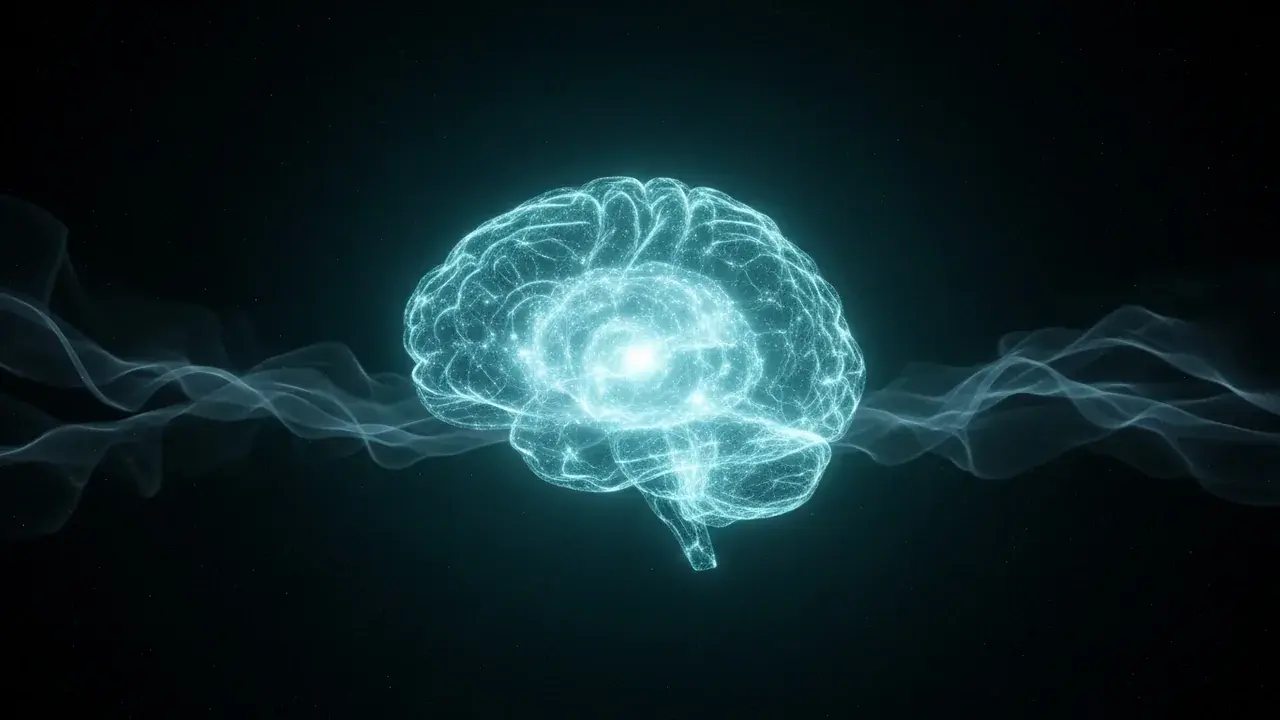
Could you be a momentary brain that fluctuated into existence with false memories of a coherent past?
In a long-lived, accelerating universe, random thermal fluctuations could spontaneously assemble a self-aware brain with false memories of a coherent life. Several modern cosmological models appear to predict such observers should statistically dominate — which is widely treated as a reason those models are wrong, not as evidence about you.
A simpler way to picture it
Before the math: what a Boltzmann brain actually is, and what it isn't.
A Boltzmann brain is a hypothetical conscious observer that randomly fluctuates into existence in an empty universe, complete with vivid but fabricated memories of a coherent past. It's not literally a brain floating in space — it's a thought experiment about the simplest possible configuration of matter that can host a single moment of experience. The disturbing feature is the math: in a sufficiently long-lived universe with thermal radiation, fluctuating a brief self-aware fragment is vastly more probable than fluctuating an entire ordered cosmos. That sets up a ratio problem most physicists treat as a stress test on cosmological models, not as a serious claim about anyone's identity.
- NOT A LITERAL BRAIN
It isn't a biological organ floating in space. It's a stand-in for the simplest configuration of matter that could host one moment of conscious experience.
- NOT A SIMULATION
Nobody designed it. The whole point is that it arises from blind statistical chance in a thermal background — not from a programmer or a dreamer.
- A THOUGHT EXPERIMENT
It's a stress test for cosmological theories: in a universe that lasts long enough, would random fluctuations vastly outnumber evolved observers? If yes, the theory has a problem.
- WHY IT MATTERS
If your model predicts that you're more likely a momentary fluctuation than a billion-year-old human, it's quietly telling you that your own evidence for the model can't be trusted.
Why physicists take this seriously
The paradox isn't a science-fiction prompt. It falls naturally out of three frameworks we already trust.
- Statistical mechanics is exact
The math behind entropy and thermal fluctuation is some of the best-understood physics we have. Once you grant a long-lived universe with positive temperature, the calculations follow without any new physics. (See SEP's entry on philosophy of statistical mechanics for the foundations.)
- Our own universe seems to be heading there
Observations of accelerating cosmic expansion suggest the universe will asymptote to a long-lived de Sitter phase — empty, cold, and permeated by faint Hawking-like radiation. That is exactly the regime where the paradox bites.
- Eternal inflation hands you infinity
Most modern inflation models are versions of eternal inflation: inflation never globally stops. That generates an unbounded multiverse in which every possible configuration occurs an infinite number of times — including Boltzmann brains.
- Comparing infinities is mathematically dangerous
Different ways of regulating the infinities — the measure problem — give wildly different answers. Several plausible measures put random fluctuations in the majority. That alone makes the paradox a live constraint.
- Anthropic reasoning cuts both ways
If we use the anthropic principle to explain the cosmological constant, we have to take observer-counting seriously across the board. That is what forces the Boltzmann-brain comparison out into the open.
- It functions as a quality control test
Working cosmologists like Don Page, Andrei Linde, Alexander Vilenkin, and Sean Carroll routinely use Boltzmann-brain dominance as a reason to reject or modify a theory. That alone is evidence the underlying reasoning has bite.
Why a brain is statistically easier than a universe
The argument is brutally simple once you grant the setup. Three steps lead to one disturbing ratio.
- 01Random fluctuations can create temporary order
In any thermal system, particles bump into ordered configurations by chance. The probability is small but non-zero, and it scales as exp(−ΔS): the bigger the entropy decrease you need, the more exponentially unlikely it becomes. Crucially, this is real physics — Brownian motion, thermal noise, and vacuum fluctuations all rely on it.
- 02A single brain is far cheaper than a universe
An ordered universe like ours has roughly 10^80 atoms and an entropy on the order of 10^122. A single observer-like fragment is a vanishingly small subset of that. The fluctuation cost of nucleating one moment of experience is enormous (~10^69 in entropy units), but the cost of fluctuating an entire low-entropy cosmos is unfathomably larger.
- 03Infinite time turns 'unlikely' into 'inevitable'
Probabilities like exp(−10^69) are absurd. The expected wait time for a single Boltzmann brain to nucleate is something like 10^(10^69) years — a number that makes the heat-death timescale look like a heartbeat. But if the universe really is future-eternal, even those wait times eventually pass, and the count of fluctuations grows without bound.
- 04The ratio problem flips the script
Ordinary observers depend on a finite, low-entropy beginning, billions of years of stellar evolution, and a finite stelliferous era. Their number is finite. Boltzmann brains, in an eternal de Sitter phase, are unbounded. Compare the two over all of cosmic time and the random fluctuations should dominate — which by the principle of mediocrity makes you statistically more likely to be one.
The strongest case for the concern
Why this isn't something working physicists can wave away.
- 01Statistical mechanics is unambiguous: in a thermal background, the probability of spontaneously fluctuating an ordered state scales as exp(−ΔS). Producing a single brief observer requires far less entropy than producing an entire low-entropy cosmos with ~10^80 atoms — so on those numbers alone, brains are exponentially easier to fluctuate than universes.
- 02Our universe appears to be heading toward a long-lived de Sitter phase whose cosmological horizon emits faint Hawking-like radiation. Given an effectively infinite future, even events with probabilities like exp(−10^69) — Boltzmann-brain nucleation — eventually occur, and over infinite time their cumulative number is infinite.
- 03Eternal inflation generates an unbounded multiverse of pocket universes. Dyson, Kleban and Susskind (2002) showed that long-lived de Sitter cosmologies with positive cosmological constant produce 'disturbing' recurrence statistics in which observable structures arise overwhelmingly from miraculous fluctuations rather than natural evolution.
- 04Different cosmological 'measures' used to compare these infinities (proper-time cutoff, scale-factor cutoff, causal patch) yield wildly different answers — and several plausible measures put Boltzmann-brain observers in the majority unless extra constraints are added.
- 05The fact that physicists like Andrei Linde, Don Page, Alexander Vilenkin, and Sean Carroll repeatedly use Boltzmann-brain dominance as a reason to reject or modify cosmological models is itself a backhanded acknowledgement that the reasoning has bite. It functions as one of the strictest internal consistency checks on theories of the long-term universe.
The strongest case against it
The literal claim that you are a Boltzmann brain falls apart on multiple, independent fronts.
- 01Cognitive instability: if you really are a Boltzmann brain, then every memory, every textbook, and every observation that motivated the theory in the first place is also a fabricated illusion. The hypothesis dismantles its own evidence base — a theory that requires you to disbelieve your own reasoning cannot be rationally adopted.
- 02Coherence over time: a momentary fluctuation should produce an instant of confused experience and immediately decohere. Your sustained, lawful, consistent ongoing experience is itself strong evidence against being a Boltzmann brain.
- 03The universe may not last long enough. Andrei Linde's work on 'sinks in the landscape' and Don Page's vacuum-decay arguments show that if our vacuum is unstable enough (some estimates require decay timescales below ~20 billion years in certain models), Boltzmann brains never get the eternal runway they need.
- 04Quantum stationarity: in Sean Carroll's 2015 argument, a far-future de Sitter vacuum settles into a time-independent quantum state. Static states do not host the out-of-equilibrium, dynamic processes that 'observation' requires — so mathematical fluctuations in the wavefunction don't produce actual observers.
- 05Substrate objections: consciousness on the only substrate we know (biological brains) requires sustained energy gradients, metabolic flow, and dynamical processes. A static thermal fluctuation in empty space lacks all of this; it would be frozen by thermal decay before producing any coherent experience.
- 06Measure-based solutions: under the scale-factor-cutoff measure, or in the dual 'comoving frame' where bounded objects contract instead of space expanding, calculations flip and ordinary evolved observers dominate without any new physics. Boltzmann-brain dominance may simply be an artifact of choosing the wrong regularization.
- 07The Rovelli–Wolpert–Scharnhorst entropy-conjecture analysis shows the argument depends on selectively trusting empirical data while using statistical mechanics to undermine it — a subtle circularity that disappears once a 'past hypothesis' (low-entropy Big Bang) is properly included.
- 08No empirical signature: there is no observation that distinguishes 'real' observers from a Boltzmann brain that happens to share the same momentary experience. The hypothesis is, by construction, untestable.
Where this stands
With both sides on the table, here's the careful read.
The Boltzmann-brain problem is a legitimate, mainstream theoretical issue in cosmology — but the literal claim that you are a Boltzmann brain is highly unlikely and self-undermining. The standard reading is roughly: any model in which random fluctuations should statistically dominate evolved observers is, for that reason alone, considered to be in trouble. Several mathematical pathways (vacuum decay into 'sinks', alternative measures, quantum stationarity, the comoving frame) suggest the dominance is an artifact of incomplete models rather than a real feature of the universe.
That comparing the relative rates of low-entropy fluctuations is a legitimate stress test for cosmological models, and that any theory predicting random observers should statistically dominate evolved ones has a serious internal problem to resolve.
That you are a Boltzmann brain, that your memories are spurious, that ordinary causal histories don't exist, or that any cosmological model that produces them must be true. Most modern resolutions show the dominance vanishes once vacuum stability, the right measure, or the right reference frame is used.
What a thought experiment about brains tells us about physics
The paradox earns its keep as a constraint on our most ambitious theories of the universe.
- It tests theories of the universe
Any model of eternal inflation, the multiverse, or the long-term fate of the cosmos has to explain why ordinary observers should still dominate. That requirement has reshaped how cosmologists work.
- It exposes the measure problem
Comparing infinities of observers requires a 'measure' to regulate them. The fact that different measures give different answers is now treated as a deep open problem in cosmology, not a technicality.
- It pressure-tests anthropic reasoning
If we appeal to anthropic selection to explain fine-tuning, we have to take the same principle seriously here. Boltzmann brains force us to define exactly what counts as an observer.
- It links physics to epistemology
The paradox shows that the laws of physics, taken to extreme statistical conclusions, can in principle generate fake but indistinguishable empirical data. That blurs the line between physical and epistemic problems.
- It illustrates how good equations can produce absurdity
Successful physics, divorced from boundary conditions like the arrow of time and the past hypothesis, can lead to nonsense. The paradox is a reminder to take those grounding assumptions seriously.
Key thinkers
Names worth knowing. Each of these has shaped how the paradox is framed today.
- Origin (1895)
Proposed in Nature that the observable low-entropy universe might be a colossal statistical fluctuation in an otherwise high-entropy cosmos — the seed idea of every later Boltzmann-brain argument.
- Modern revival (2002)
Their ‘Disturbing Implications of a Cosmological Constant’ connected the paradox to our accelerating universe and reignited modern interest in it.
- Andreas Albrecht & Lorenzo SorboInflation comparison (2004)
‘Can the universe afford inflation?’ formalised the entropic comparison between inflating universes and direct fluctuations into observers.
- Don N. PageVacuum decay constraints
Argued (2008 onward) that to avoid Boltzmann-brain dominance our vacuum must decay on a timescale comparable to or shorter than BB nucleation — in some models, less than ~20 Gyr.
- Andrei LindeSinks in the landscape (2007)
Showed that terminal vacua acting as ‘sinks’ in the string-theory landscape can drain probability flow away from BB-producing regions.
- Alexander VilenkinMeasure problem
Developed the proper-time and scale-factor cutoffs that frame how observer-counting in eternal inflation is even attempted, and coined 'freak observers' for the broader class.
- Sean M. CarrollCognitive instability (2017)
Argued that any cosmology in which you are typically a Boltzmann brain is ‘cognitively unstable’ — it cannot be both true and rationally believed. Co-author with Boddy & Pollack on the de Sitter sterility argument.
- Bayesian epistemology
Probed the limits of cognitive instability with bracketing arguments and Bayesian analyses of self-locating credences in 'large' cosmologies.
- Markov-process critique
Used Markov-process theory to expose the circular structure of the H-theorem version of the argument and argue that the past hypothesis dissolves it.
Common questions
Short answers to the questions readers usually arrive with.
- Q01Are Boltzmann brains real?
There is no empirical evidence that Boltzmann brains exist. They are a mathematical consequence of combining certain assumptions about thermodynamics, infinite time, and cosmology. Physicists use the concept as a stress test: if a theory predicts that they dominate, that is generally treated as a sign the theory is wrong or incomplete.
- Q02Could I be a Boltzmann brain?
Almost certainly not, on multiple grounds. A momentary fluctuation should produce one instant of incoherent experience and immediately decohere — your stable, lawful, ongoing experience is itself strong evidence against being one. And the moment you take the hypothesis seriously, you have to discard the very physics you used to formulate it.
- Q03Is this accepted science?
The problem is mainstream. The existence of Boltzmann brains is not. The calculations for entropy, de Sitter space, and thermal fluctuations are rigorous, widely accepted physics. Modern cosmologists debate which mechanism (vacuum decay, the right measure, quantum stationarity, frame choice) cleanly resolves the paradox — not whether the paradox is real.
- Q04Why do physicists talk about this if it sounds absurd?
It works as a reductio ad absurdum. When developing theories of the multiverse or eternal inflation, you can't have your model imply that a typical observer is a random hallucination. The Boltzmann-brain argument is one of the strictest internal consistency checks we have on theories of the long-term universe.
- Q05Does this prove the universe is fake or a simulation?
No. The paradox is strictly about thermal and quantum fluctuations under known physics. It has nothing to do with intelligent design, computer simulations, or constructed realities. The philosophical kinship with ‘brain in a vat’ arguments is real but the mechanism is completely different.
- Q06What would count against Boltzmann brains?
Several things. The universe decaying or collapsing before BBs can form (Linde, Page). A truly stationary far-future quantum vacuum that doesn't host dynamic observation (Boddy, Carroll, Pollack). The biological requirement for sustained energy gradients. Or simply choosing a different cosmological measure (scale-factor cutoff, comoving frame) that puts ordinary observers back on top.
- Q07What is the measure problem?
When the universe expands eternally and creates a multiverse, every possible thing happens infinitely often. To say what's 'typical', you need a measure to compare those infinities. Different measures give wildly different answers — and the appearance of Boltzmann-brain dominance is often a symptom of choosing the wrong one.
- Q08What is cognitive instability?
If a theory implies that your memories and reasoning are random fluctuations, then the empirical evidence and reasoning you used to build the theory in the first place is also suspect. The theory destroys its own evidence base. Sean Carroll calls this ‘cognitive instability’ and treats it as a sufficient reason to reject any cosmology that predicts BB dominance.
Phenomenon vs interpretation
The signature distinction. We score the underlying observation separately from the metaphysical framework usually attached to it.
Evidence the reported observation is real.
Evidence the bigger explanation is correct.
Headline score (defaults to phenomenon score for phenomena).
Distance between data and conclusion.
What a thoughtful person might do with this
Treat the paradox as a methodological tool for cosmologists, not a live hypothesis about your own existence. The self-undermining structure means acting on it is incoherent — if you really were a momentary fluctuation, no decision you make matters or persists. Your stable, coherent, ongoing experience is itself the strongest available evidence against the literal interpretation.
How belief in this can go wrong
Has been used to fuel a particularly corrosive form of nihilism ("none of this is real, my memories are fake, nothing matters"). The standard responses — your coherent ongoing experience is itself evidence against being one; cosmologies that produce them are probably wrong; the hypothesis destroys its own evidence base — are well-developed and worth knowing before letting the idea bite too deep.
Where this came from
The conversation from Boltzmann's 1895 note to today.
The kernel appears in Ludwig Boltzmann's 1895 paper in Nature, where he speculated that the observed low-entropy region of the universe might be a colossal statistical fluctuation in an otherwise high-entropy cosmos. The modern formulation arrived in 2002 with Dyson, Kleban and Susskind's 'Disturbing Implications of a Cosmological Constant', which connected the problem to the accelerating expansion of our universe, and Albrecht and Sorbo's 'Can the universe afford inflation?'. Don Page, Andrei Linde, Alexander Vilenkin, and Sean Carroll developed the argument throughout the 2000s and 2010s; Carroll's 2017 'Why Boltzmann Brains Are Bad' and his book From Eternity to Here treat the topic in detail. More recently Carlo Rovelli, David Wolpert and Jordan Scharnhorst have used Markov-process theory to disentangle the circular structure of the H-theorem version, and several measure-theoretic and frame-based resolutions (causal patch, scale-factor cutoff, comoving frame) have been proposed. The paradox remains a vital stress test for any theory of eternal inflation or the long-term fate of the universe.
Audit trail
The 11 internal criteria informing the headline scores. They're not arithmetically averaged — they're the audit trail.
Related claims
Sources & Further Reading
Our goal is to link to original studies, academic sources, and serious critiques wherever possible. Scores are provisional until sources are verified.
Primary sources
On Certain Questions of the Theory of Gases
The historical origin of the entire fluctuation-cosmology line of reasoning.
Disturbing Implications of a Cosmological Constant
The paper that reignited modern interest in the Boltzmann-brain problem by linking it directly to the accelerating expansion of our universe.
Can the universe afford inflation?
One of the canonical modern statements of the Boltzmann-brain comparison and its implications for inflation.
Is our universe likely to decay within 20 billion years?
The clearest statement of how the Boltzmann-brain count is tamed by a finite vacuum lifetime; companion paper to 'Return of the Boltzmann brains'.
Why Boltzmann Brains Are Bad
The standard reference for the cognitive-instability resolution and the philosophical case against taking Boltzmann-brain dominance as a real prediction.
Sinks in the Landscape, Boltzmann Brains, and the Cosmological Constant Problem
Sets up one of the main physical pathways for resolving the paradox — vacuum decay into terminal states before BBs can dominate.
Further reading
From Eternity to Here: The Quest for the Ultimate Theory of Time
The most accessible book-length introduction to why physicists worry about the Boltzmann-brain problem and how it interacts with the arrow of time.
Many-Worlds Interpretation of Quantum Mechanics
The default scholarly reference for what Many-Worlds actually claims and where it is contested.
De Sitter space
Useful conceptual reference for any claim about long-term cosmology and the cosmological-horizon temperature.
Challenging / sceptical perspectives
Why Boltzmann Brains Don't Fluctuate Into Existence From the De Sitter Vacuum
Major physical objection to Boltzmann-brain dominance: the static de Sitter vacuum is sterile, so the mathematical fluctuation probability does not translate into real observers.